
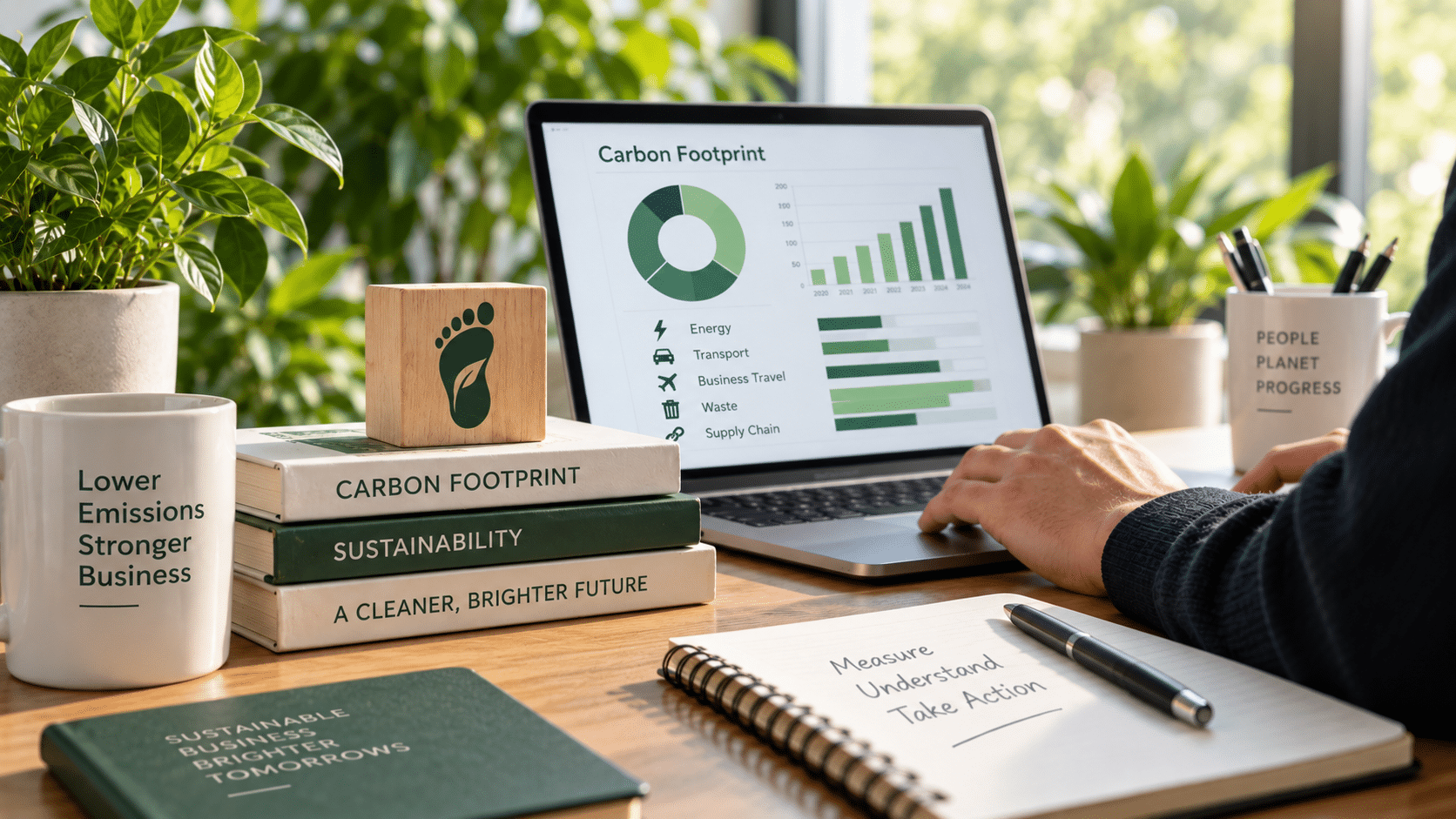
If you’ve been asked for your company’s carbon footprint, you might not know exactly what that means or what you’re expected to provide.
What counts as a business carbon footprint? Which emissions should be considered? How is a footprint measured? And what can you actually learn from the results?
A carbon footprint gives a business a way to understand the greenhouse gas emissions associated with its activities over a defined period of time.
For some businesses, calculating a carbon footprint is prompted by a customer, contractor or tender requirement. For others, it is part of a wider effort to understand their environmental impact and identify where emissions could be reduced.
Either way, the starting point is understanding what a business carbon footprint actually is and what the results mean.
This guide explains business carbon footprints in plain English, including what they cover, how they relate to Scope 1, 2 and 3 emissions, why data quality matters, how to interpret the results and what a business can do with the information.
What is a business carbon footprint?
A business carbon footprint is a measurement of the greenhouse gas emissions associated with an organisation over a defined reporting period.
The results are normally expressed as carbon dioxide equivalent (CO₂e).
CO₂e provides a common way of expressing the climate impact of different greenhouse gases in terms of their equivalent impact compared with carbon dioxide.
A business carbon footprint can include emissions associated with activities such as:
- Energy use
- Fuel
- Transport
- Business travel
- Waste
- Purchased goods and services
- Employee commuting
- Other relevant activities within the organisation’s value chain
Exactly what is included depends on the organisation, its activities, the boundaries being used and why the footprint is being calculated.
There is therefore no single carbon footprint that looks the same for every business.
A manufacturing company, professional services business and construction contractor are likely to have very different sources of emissions.
The important question is not simply:
“How big is our carbon footprint?”
It is also:
“What does our carbon footprint tell us about our business?”
Why do businesses calculate their carbon footprint?
There are a number of reasons a business may need or choose to calculate its carbon footprint.
A customer or contractor may ask for carbon information as part of their supply-chain requirements. Carbon information can also form part of a tender, procurement process or ESG questionnaire.
For other businesses, the reason is more straightforward: they want to understand where their emissions come from.
Knowing the size and make-up of a carbon footprint can provide a useful starting point for identifying where emissions may be reduced.
The reason for calculating a footprint matters because it helps determine what information is relevant and how the results should be used.
For example, a business responding to a specific customer requirement may have a different reporting need from a business that wants to use its footprint as a baseline for longer-term carbon reduction.
The calculation is therefore not simply about producing a number.
It is about producing information that is useful for the purpose it is intended to serve.
What does a business carbon footprint include?
A business carbon footprint can include emissions from many different activities across an organisation and its value chain.
The GHG Protocol groups organisational emissions into three broad categories:
- Scope 1 – direct emissions from sources an organisation owns or controls
- Scope 2 – indirect emissions associated with purchased energy
- Scope 3 – other indirect emissions associated with activities across the organisation’s value chain
Not every business will have relevant emissions in every Scope 3 category, and the significance of different emission sources will vary between organisations.
For a detailed explanation of the three Scopes, see Scope 1, 2 and 3 Emissions: A Complete Guide for UK Businesses.
The important point here is that the three Scopes provide a way of categorising emissions. Together, the relevant emissions form part of the business’s overall carbon footprint.
Carbon footprint vs Scope 1, 2 and 3
These terms are often used together, which can make them confusing.
A carbon footprint is the overall measurement of relevant greenhouse gas emissions associated with an organisation over a defined period.
Scope 1, Scope 2 and Scope 3 are categories used to organise those emissions.
Put simply:
Business activities
↓
Relevant Scope 1 + Scope 2 + Scope 3 emissions
↓
Business carbon footprint
The Scopes are therefore not three separate carbon footprints. They are different categories within the overall picture of an organisation’s emissions.
The balance between the Scopes can vary considerably from one business to another.
For some organisations, direct fuel or energy use may represent a significant proportion of emissions. For others, purchased goods, services, transport or other value-chain activities may account for much more of the footprint.
Understanding that difference is one of the reasons a carbon footprint can be useful.
For more detail on individual emissions categories, see the existing Scope 1 emissions and Scope 2 emissions guides, and our guide to Scope 3 emissions.
How is a business carbon footprint calculated?
At its simplest, a carbon footprint calculation involves using information about business activities together with appropriate emissions factors to estimate the associated greenhouse gas emissions.
A commonly used principle is:
Activity data × emissions factor = estimated emissions
For example, information about electricity consumption can be combined with an appropriate emissions factor to estimate the associated emissions.
The same principle can be applied to many other types of activity, including fuel, transport, travel and waste.
The exact approach depends on the activity being measured, the information available and the methodology being used.
There are different approaches to calculating emissions, and the most appropriate method can depend on the type of data available.
For a more detailed explanation, see Understanding Emission Calculation Methods.
The important thing to understand is that a carbon footprint is a calculation based on activity data and methodology. It is not a direct measurement of greenhouse gases in the atmosphere.
What are UK Government conversion factors?
The UK Government publishes greenhouse gas conversion factors that businesses can use when calculating and reporting emissions.
These factors help convert information about an activity into an estimated quantity of greenhouse gas emissions.
For example, a business might have information about:
- Electricity consumption
- Fuel use
- Vehicle mileage
- Business travel
- Waste
An appropriate conversion factor can then be applied to the relevant activity data.
The factor used depends on the activity and the reporting year, which is why it is important to use the appropriate factors for the period being calculated.
Conversion factors can be updated, so businesses comparing carbon footprints over different years need to take changes in the factors into account.
How important is data quality?
The quality of a carbon footprint depends partly on the quality of the information used to calculate it.
A footprint may draw on information from a number of different parts of a business, and the level of detail available can vary.
Factors that can affect the quality of the result include:
- The quality of the underlying activity data
- The methodology used
- The emissions factors available
- The level of detail in the information
- Any assumptions or estimates
- The boundaries used for the calculation
Better activity data can generally provide a clearer picture of what is happening within a business.
For example, knowing how much fuel was actually used provides different information from relying on an estimate.
However, perfect data is not always available, particularly when a business is calculating its carbon footprint for the first time.
That does not automatically make a carbon footprint unusable.
What matters is understanding the quality of the information, recognising where estimates have been made and documenting important assumptions.
A useful carbon footprint is not necessarily one with no estimates.
It is one where the data, methodology and assumptions are understood.
What if a business doesn’t have all the data?
Missing information is common when a business starts looking at its carbon footprint.
There may be gaps in areas such as:
- Business travel
- Waste
- Transport
- Supplier information
- Historical records
- Other value-chain activities
It is important not to assume that missing information means a carbon footprint cannot be calculated.
Depending on the circumstances, estimates or alternative sources of information may be appropriate.
The important thing is to understand where information is incomplete, recognise any assumptions that have been made and consider how the quality of the information could be improved over time.
A first carbon footprint can also highlight where better data would be useful in future.
That means the process can become more informative as the business improves the way it records and manages its environmental data.
Do businesses need to measure every emission?
Not necessarily.
It can be tempting to think that a carbon footprint needs to include every possible source of emissions before it has any value.
In practice, what is relevant depends on the organisation and the purpose of the calculation.
A business responding to a particular customer or procurement requirement may have specific information it needs to provide.
Another business may want a broader understanding of its emissions because it is beginning to consider carbon reduction.
The important thing is to understand the purpose of the footprint and consider which emissions are relevant to that purpose.
Collecting more information does not automatically produce a more useful carbon footprint.
The aim is to produce information that is relevant, consistent and useful.
How accurate is a business carbon footprint?
There is no single answer to how accurate a carbon footprint is.
Its quality depends on the data, methodology, emissions factors and assumptions behind the calculation.
For example, two businesses could be looking at similar activities but have different levels of information available.
One might have detailed activity data, while another might need to use estimates.
That does not necessarily mean one business has a useful footprint and the other does not. It means the results need to be understood in context.
It is also important to recognise that a carbon footprint is an estimate based on a defined methodology.
The aim is not to produce a number that appears more precise than the information supports.
Instead, businesses should understand:
- Where the data came from
- Which methodology was used
- Where estimates were made
- What assumptions were necessary
- What the results can and cannot tell them
This becomes particularly important when carbon footprints are compared from one year to another.
How often should a business calculate its carbon footprint?
Businesses that want to track their emissions over time will generally need to repeat their carbon footprint calculations consistently.
Doing this can help show whether emissions are changing and where progress may be occurring.
However, year-on-year comparisons need to be treated carefully.
A change in reported emissions could result from:
- A genuine change in business activity
- Changes in energy consumption
- Changes in the size of the organisation
- Better quality data
- Changes in methodology
- Updated emissions factors
- Changes to organisational boundaries
So if a reported footprint goes down, that does not automatically mean the business has reduced its underlying emissions.
The context behind the numbers matters.
A useful comparison looks not only at whether the footprint changed, but also at why it changed.
What can a business learn from its carbon footprint?
A carbon footprint provides more than one overall emissions figure.
It can help a business understand:
- Where its emissions are coming from
- Which activities contribute most to its footprint
- Where data could be improved
- Which areas may need further investigation
- Where there may be opportunities for carbon reduction
- How emissions are changing over time
The results may sometimes challenge assumptions.
A business might expect energy use to be its largest source of emissions, for example, but find that purchased goods, transport or another part of its value chain contributes more.
That is one of the useful things about measuring a carbon footprint.
It replaces assumptions with information.
The value is not simply in knowing the final number.
It is in understanding what sits behind that number and what it tells you about the business.
Carbon footprint vs Carbon Reduction Plan
A carbon footprint and a Carbon Reduction Plan serve different purposes.
A carbon footprint measures emissions and establishes a baseline.
A Carbon Reduction Plan uses information about emissions to identify actions and set out how emissions could be reduced over time.
In simple terms:
Carbon footprint = Where are we now?
Carbon Reduction Plan = What are we going to do next?
The two can work together, but one does not replace the other.
See our Carbon Reduction Plan service if your business needs to turn its emissions baseline into a practical reduction roadmap.
You can also read [Carbon Reduction for UK Businesses: A Practical Guide] for a broader explanation of reducing business emissions.
Carbon footprint vs Net Zero
A carbon footprint is a measurement.
Net Zero is a longer-term objective.
Calculating a carbon footprint does not mean that a business is Net Zero.
Instead, a carbon footprint can provide a baseline from which a business can understand its emissions, consider reduction opportunities and develop its longer-term approach.
This is why measuring emissions is often an important part of a wider Net Zero journey.
For a broader explanation, see [Net Zero for UK Businesses: A Practical Guide].
Common carbon footprint mistakes
Trying to measure everything at once
It can be tempting to collect as much information as possible.
But more information does not automatically mean a better carbon footprint.
Start by understanding what you are trying to achieve and which emissions are relevant.
Treating estimates as exact figures
Estimates may sometimes be necessary.
The important thing is to recognise where estimates have been used and understand their limitations.
Ignoring data quality
The information behind the calculation affects how useful the results are.
Understanding where data comes from and where assumptions have been made can make future calculations more consistent.
Comparing figures without looking at the methodology
A change in reported emissions may reflect changes in data, methodology, emissions factors or organisational boundaries rather than an actual reduction.
Year-on-year figures need context.
Focusing only on the final number
The total footprint is useful, but it does not explain everything.
Understanding where emissions come from is what makes the information useful.
Calculating emissions without using the results
There is limited value in producing a carbon footprint and then doing nothing with the information.
Depending on the reason for calculating it, the results might support reporting, customer requirements, procurement decisions, carbon reduction planning or future assessments.
What should a business do with its carbon footprint?
There is no single next step that applies to every organisation.
The appropriate response depends on why the footprint was calculated and what the results show.
A business might use its carbon footprint to:
- Respond to a customer or tender requirement
- Improve the quality of its emissions data
- Understand its main sources of emissions
- Identify areas that need further investigation
- Support carbon reduction planning
- Track changes over time
- Inform longer-term Net Zero planning
The footprint provides a picture of the business’s emissions at a particular point in time.
The next step is deciding what that information means for the organisation.
That might mean improving data, investigating a particular source of emissions, developing a Carbon Reduction Plan or simply establishing a baseline against which future progress can be measured.
Frequently asked questions
What is a carbon footprint for a business?
A business carbon footprint is a measurement of the greenhouse gas emissions associated with an organisation over a defined reporting period.
It can include relevant Scope 1, Scope 2 and Scope 3 emissions, depending on the organisation and the purpose of the calculation.
Why do businesses calculate their carbon footprint?
Businesses may calculate their carbon footprint because a customer, contractor or procurement team has requested the information. Others want to understand their environmental impact, support carbon reduction planning or establish a baseline for future reporting.
What does a business carbon footprint include?
It can include emissions associated with energy, fuel, transport, travel, waste, purchased goods and services and other relevant activities.
Exactly what is included depends on the organisation and the purpose of the calculation.
Is a carbon footprint the same as Scope 1, 2 and 3?
No.
Scope 1, Scope 2 and Scope 3 are categories used to organise an organisation’s greenhouse gas emissions. A carbon footprint brings together the relevant emissions to provide an overall picture for a defined reporting period.
See our Scope 1, 2 and 3 Emissions: A Guide for UK Businesses for more detail.
Is a carbon footprint the same as Net Zero?
No.
A carbon footprint measures an organisation’s greenhouse gas emissions. Net Zero is a longer-term objective involving the reduction of emissions and the appropriate treatment of residual emissions.
Is a carbon footprint the same as a Carbon Reduction Plan?
No.
A carbon footprint establishes a baseline and shows where emissions come from. A Carbon Reduction Plan uses information about emissions to identify actions and plan how emissions could be reduced.
Understanding your business carbon footprint
A carbon footprint is more than a number.
It can help a business understand where its emissions come from, identify gaps in its data and provide a clearer starting point for future decisions.
The most useful carbon footprint is one that is appropriate to the business, based on a clear methodology and understood in context.
If you’ve been asked to provide a carbon footprint by a customer or contractor, need emissions information for a tender, or want to establish a baseline for carbon reduction, Attain Zero’s Carbon Footprint Assessments can help.
Related carbon reporting guides
Scope 1, 2 and 3 Emissions: A Complete Guide for UK Businesses
Understand the three emissions Scopes, what they mean and how they apply to UK businesses.
Understanding Emission Calculation Methods
Learn more about the different approaches used to calculate greenhouse gas emissions.
Carbon Reduction for UK Businesses: A Practical Guide
Understand how businesses can identify and approach opportunities to reduce their emissions.
Net Zero for UK Businesses: A Practical Guide
A practical introduction to Net Zero and how carbon reduction and emissions measurement fit into a longer-term approach.